
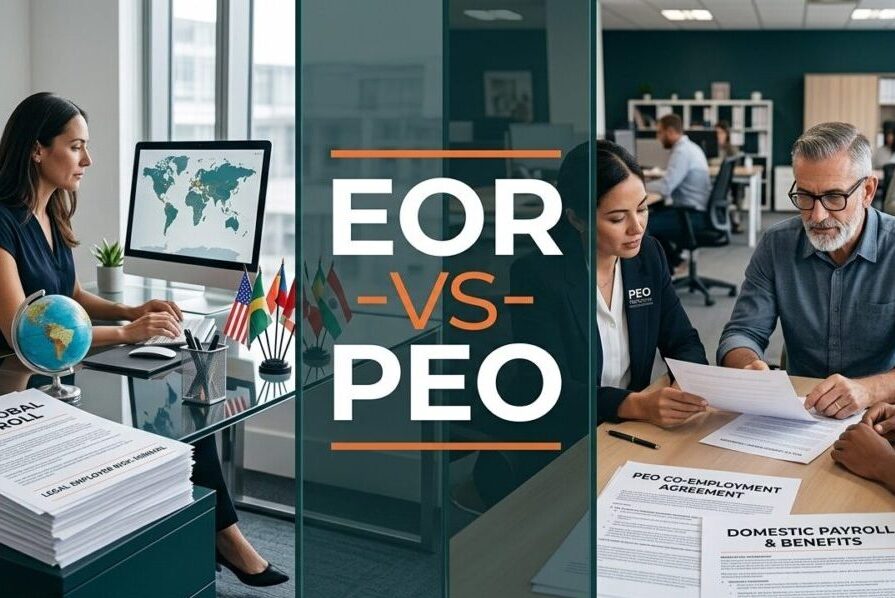
Employer of Record vs PEO in the US: What’s the Real Difference?
Employer of Record (EOR) and Professional Employer Organization (PEO).
- Legal responsibility
- Cost structure
- Control over employees
- Compliance risk
What is an Employer of Record (EOR)?
An Employer of Record (EOR) is a third-party provider that legally employs workers on your behalf.
They handle:
- Payroll processing
- Tax filings
- Compliance management
- Employment contracts
You manage the employee’s work
The EOR handles everything legal and administrative
Best For:
- Companies wanting speed and flexibility
- Businesses without internal HR infrastructure
- Organizations looking to avoid compliance burden
What is a PEO (Professional Employer Organization)?
A PEO operates under a co-employment model.
This means:
- You and the PEO share employer responsibilities
- You must have your own legal entity
- You remain partially liable for compliance
PEO supports HR
You still carry legal and operational responsibility
Best For:
- Established companies with HR teams
- Businesses comfortable managing compliance jointly
EOR vs PEO: Side-by-Side Comparison
| Factor | Employer of Record (EOR) | PEO |
|---|---|---|
| Legal Employer | EOR | Shared (Co-employment) |
| Compliance Liability | Fully handled by EOR | Shared |
| Legal Entity Required | No | Yes |
| Control Over Employees | Full control | Shared |
| Setup Time | Fast (days) | Moderate |
| Flexibility | High | Limited |
| Risk Exposure | Low | Medium |
Key takeaway:
EOR offers simplicity and lower risk, while PEO requires shared responsibility.
Cost Comparison: EOR vs PEO in the US
Understanding cost is critical for decision-makers.
EOR Pricing:
- Flat monthly fee per employee
- OR 10–15% of payroll
PEO Pricing:
- Percentage of payroll (often bundled)
- Additional admin & benefits costs
Hidden Cost Factors
| Cost Element | EOR | PEO |
|---|---|---|
| HR Infrastructure | Included | Partially required |
| Compliance Risk Cost | Low | Medium |
| Employee Benefits Admin | Included | Shared |
| Internal HR Team Cost | Not required | Often required |
Insight:
EOR may look slightly higher upfront but reduces hidden operational costs significantly.
Compliance & Risk: The Real Deciding Factor
In the US, compliance is critical.
With EOR:
- Payroll taxes handled
- Labor law compliance managed
- Misclassification risk minimized
You transfer legal burden completely
With PEO:
- Shared compliance responsibility
- Risk still partially yours
- Requires internal oversight
Mistakes can directly impact your company
When Should You Choose EOR Over PEO?
Choose EOR if you want:
- Faster hiring without HR setup
- Lower compliance exposure
- Minimal administrative overhead
- Flexibility to scale workforce
When Does PEO Make Sense?
Choose PEO if:
- You already have an HR team
- You want support, not full outsourcing
- You’re comfortable with shared responsibility
Final Verdict: Which One is Better?
There is no universal answer — but for most growing companies:
EOR is better when:
- You want speed
- You want simplicity
- You want to reduce risk
PEO works when:
- You already have structure
- You only need HR support
CTA – Conversion Section
If you’re evaluating whether EOR is the best fit for your business, our experts can help you compare options and make the right decision. Get a tailored cost estimate, understand compliance risks, and choose the most efficient workforce model for your company.